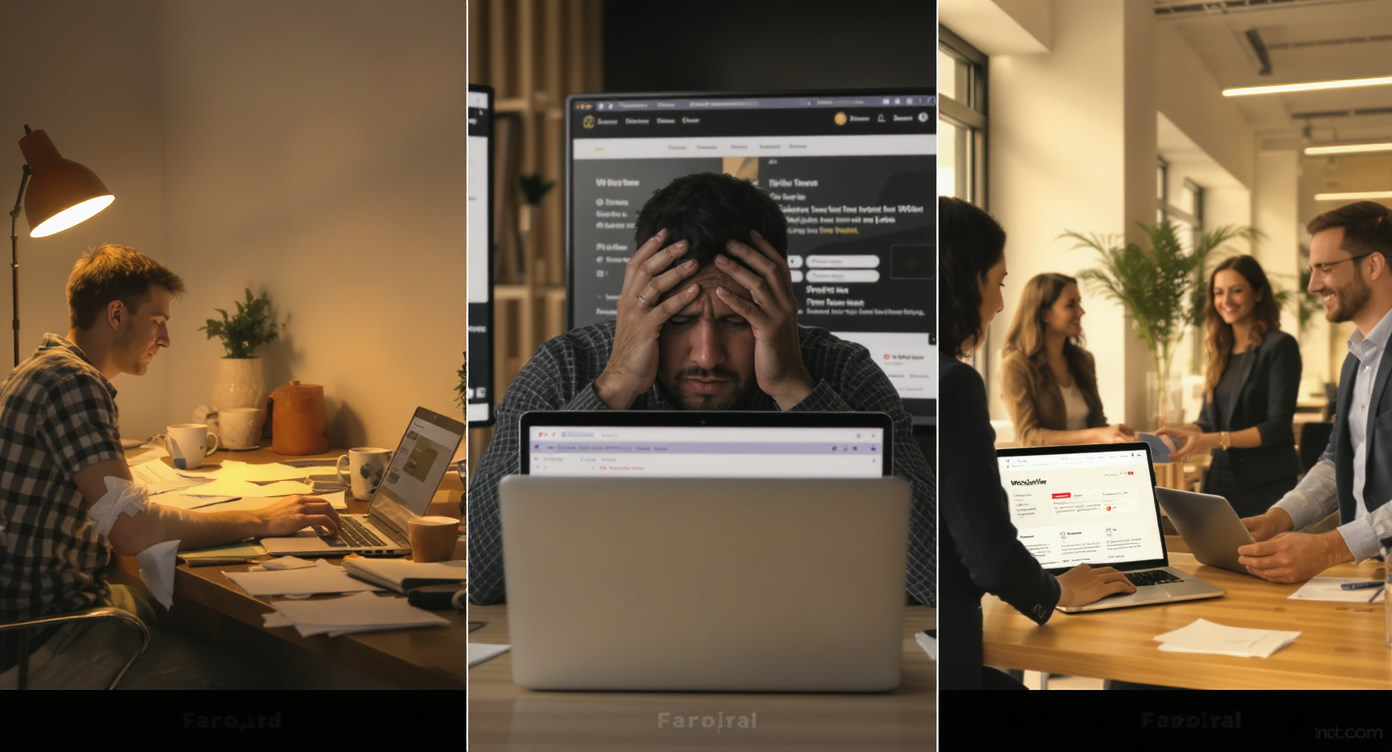
The Decision Every Business Owner Faces
You have decided your business needs a website. Good. But now comes the confusing part: how do you actually get one built? The internet will give you three main options, each with passionate advocates and horror stories. Let us break them down honestly.
Option 1: Hire a Freelancer
This is the traditional approach. You find a web developer on Fiverr, Upwork, or through a friend of a friend. You explain what you need, they quote a price, and you wait.
Pros
- Full customization: A skilled freelancer can build exactly what you envision, including custom features, unique animations, and complex functionality.
- Personal attention: You work directly with the person building your site. There is no ticket system or support queue.
- Ownership: You typically get full ownership of the code and can host it anywhere.
Cons
- Unpredictable timelines: "2 weeks" often becomes 2 months. Freelancers juggle multiple projects, and yours may not be the priority.
- Quality varies wildly: A Rs 5,000 freelancer and a Rs 50,000 freelancer deliver very different results. Vetting skill is hard if you are not technical.
- No ongoing support: Once the project is delivered, the freelancer moves on. Need a change in 6 months? Good luck getting a response. Many business owners end up hiring a second freelancer to fix what the first one built.
- Hosting is your problem: You need to buy hosting separately, manage renewals, handle security updates, and fix anything that breaks.
- Cost: A decent freelancer in India charges Rs 15,000-50,000 for a small business website. Plus Rs 5,000-10,000/year for hosting and domain.
Option 2: DIY Website Builders (Wix, WordPress, Squarespace)
These platforms let you build your own website using drag-and-drop editors and templates. WordPress powers 40% of the internet, Wix is popular for its simplicity, and Squarespace is known for beautiful designs.
Pros
- Lower cost: Plans range from Rs 3,000-12,000/year depending on the platform and features.
- Full control: You can make changes anytime without depending on anyone.
- Large template libraries: Thousands of pre-designed templates to choose from.
- Plugins and extensions: WordPress alone has 60,000+ plugins for everything from SEO to e-commerce.
Cons
- Time investment: Learning the platform, choosing a template, customizing it, adding content, and optimizing for mobile takes 20-40 hours minimum. That is a week of full-time work.
- "Easy" is relative: Wix is easy for tech-savvy people. For a shopkeeper in Nagpur who uses WhatsApp and YouTube, it is a steep learning curve.
- Template trap: Your website ends up looking like every other website using the same template. Customization beyond the template's limits requires coding knowledge.
- Performance issues: WordPress sites with too many plugins become slow. Wix sites often score poorly on PageSpeed. Slow websites lose customers.
- Security and maintenance: WordPress sites need regular updates, security patches, and backups. Skip these and you risk getting hacked.
- Hidden costs: Premium templates (Rs 3,000-8,000), plugins (Rs 2,000-10,000/year), professional photos, and domain registration add up quickly.
Option 3: Managed Website Service (Like Topiko Sites)
This is a newer category. You tell the service what your business does, and they handle everything: design, development, hosting, domain, SEO, and ongoing updates. You pay a flat annual fee.
Pros
- Zero effort from you: You share your business details and get a finished website. No learning curves, no hiring, no project management.
- Speed: Most websites are ready in 4-24 hours. Not weeks or months.
- All-inclusive pricing: Domain, hosting, SSL, SEO setup, WhatsApp integration, and support are included in one annual fee.
- Ongoing support: Need to update your menu? Change your phone number? Add a new service? Just message on WhatsApp and it gets done.
- Performance guaranteed: Services like Topiko guarantee 95+ PageSpeed scores. Your website loads fast on every device.
Cons (being honest)
- Less customization: You cannot build a complex e-commerce store with 500 products or a SaaS dashboard. Managed services work best for standard business websites (1-10 pages).
- Platform dependency: Your website lives on the service's infrastructure. If you cancel, you need to rebuild elsewhere (though Topiko lets you export your content).
- Not for developers: If you enjoy coding and want to tinker with your website, this approach will frustrate you.
Side-by-Side Comparison
| Factor | Freelancer | DIY Builder | Managed Service |
|---|---|---|---|
| Year 1 Cost | Rs 20,000-60,000 | Rs 5,000-20,000 | Rs 6,000 |
| Your Time Required | 5-10 hours | 20-40 hours | 1-2 hours |
| Timeline | 2-8 weeks | 1-4 weeks | 4-24 hours |
| Design Quality | Varies (hit or miss) | Template-based | Professional, consistent |
| PageSpeed | 50-90 (varies) | 40-70 (often slow) | 95+ (guaranteed) |
| Ongoing Support | None (project-based) | Self-service | WhatsApp support included |
| Hosting Included | No (separate cost) | Yes (with plan) | Yes |
| Domain Included | No | Sometimes | Yes |
| Customization | Unlimited | Medium | Standard (1-10 pages) |
Which Option Fits You?
Choose a freelancer if:
You need something truly custom (e-commerce with 100+ products, a booking system with complex rules, a web app). You have a budget of Rs 30,000+ and can afford to wait 4-8 weeks. You have someone technical on your team who can manage the website after launch.
Choose a DIY builder if:
You enjoy technology and have 20+ hours to invest. You want full control over every pixel. You are comfortable troubleshooting issues yourself. You do not mind a learning curve. This option is best for tech-savvy entrepreneurs, bloggers, and side projects.
Choose a managed service if:
You want a professional website without spending time on it. Your budget is Rs 6,000-15,000/year. You need a standard business website (home, about, services, contact, blog). You want someone else to handle hosting, updates, and technical issues. This covers 80% of Indian small businesses.
There is no universally "best" option. The right choice depends on your budget, technical comfort, timeline, and what kind of website you need. But for the vast majority of Indian small businesses, a shop, a clinic, a restaurant, a service provider, a managed service gives you the best result for the least effort and cost.